Worked example
When the job moves around, where do you live?

A worked example. A sponsored carpenter lands in Perth, the sites change every few months, and their partner works in the city. Two constraints, one map.
This one is made up. The family doesn't exist, but the search is real and so are the numbers, so you can see what the answer looks like rather than take my word for it.
Say a carpenter gets sponsored to Perth. The visa ties them to the firm, the firm builds houses right across the metro, and the sites change every few months, so there is no one place they go to every day. Their partner works in the city, five days a week and fixed. Between them they have two kids, one in primary and one about to start secondary, and they are renting for the first couple of years on a budget of about seven hundred a week. Now find them somewhere to live.
The problem with a job that moves
If you are a nurse or a teacher then work is a building and the building stays put, so you measure from it and you are done. A trade doesn't get that, because the site they are on today isn't the site they will be on at Christmas and neither of them is the thing they actually report to.
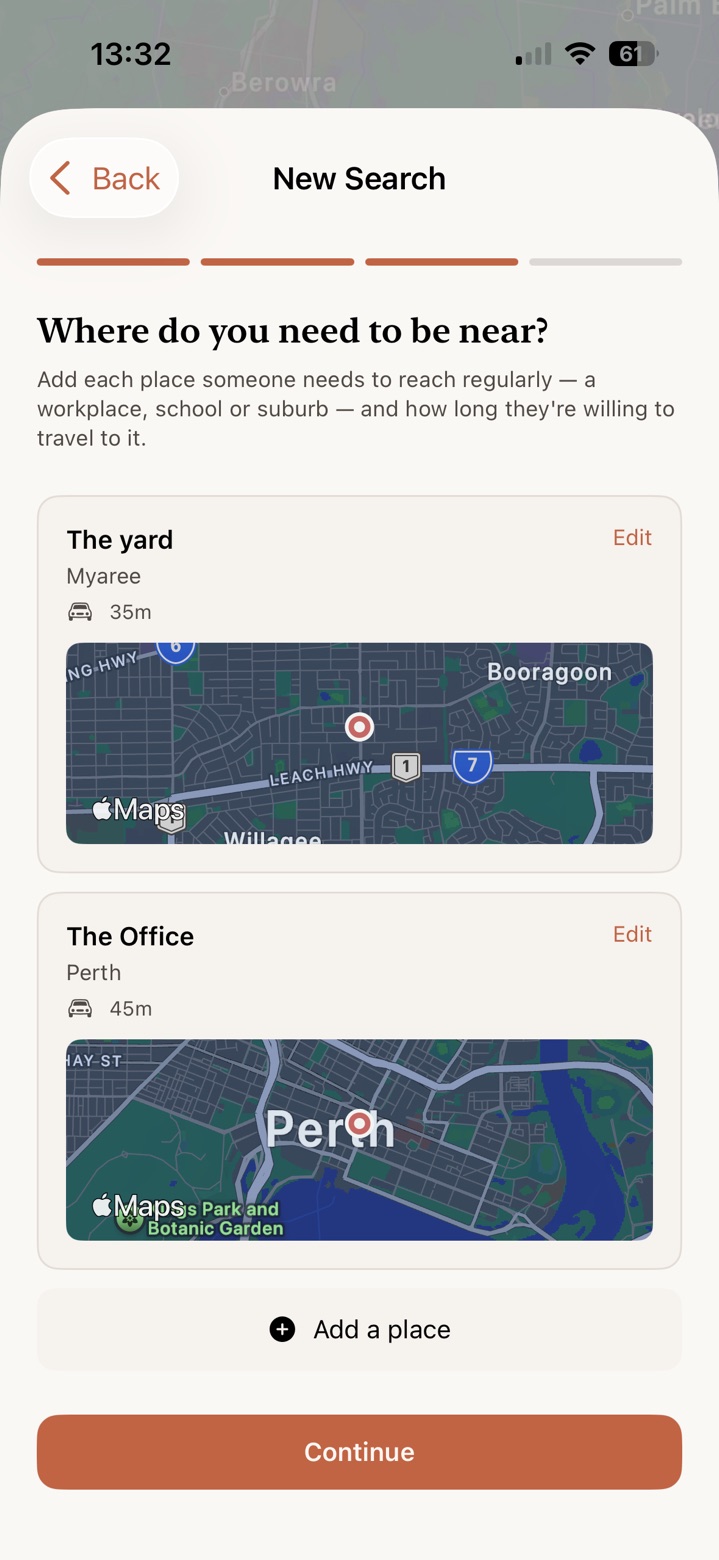
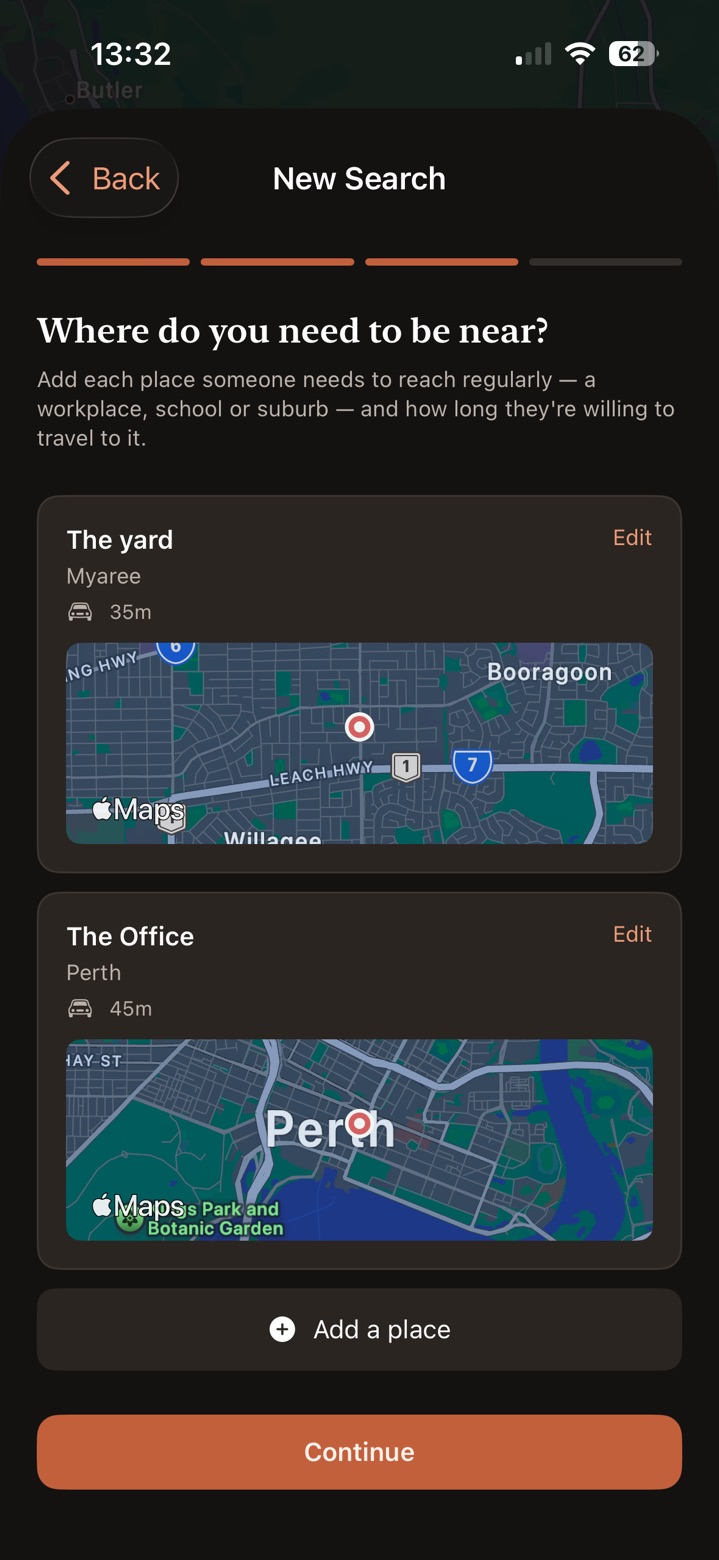
What stays still is the yard, and that is where the day starts, where the ute gets loaded and where the paperwork lives, so that is the pin you measure from. For this example it sits in Myaree, south of the river, which is the sort of place a builder keeps its operations. The partner's office is the second pin, in the middle of the city, and the two of them are about eleven kilometres apart pulling in opposite directions.
That is the whole problem, and it is the same one we had in New South Wales. Where one of you works and where you live are not the same question, and when both of you work the map ends up with two centres instead of one.
What went in
The city is Perth, the yard in Myaree is a 35 minute drive at most, and the office in the city is a 45 minute drive at most. They need primary and secondary schools, and rent up to seven hundred a week.
Both of those are drive times, because the app measures driving at the moment, rather than a train timetable. It gives a normal figure and a peak one for every leg, and every number below is the peak, because that is the run somebody actually does on a work morning.
Two places, two limits
The yard is a suburb, not a street address. A site changes every few months; the operations base does not.
What came back
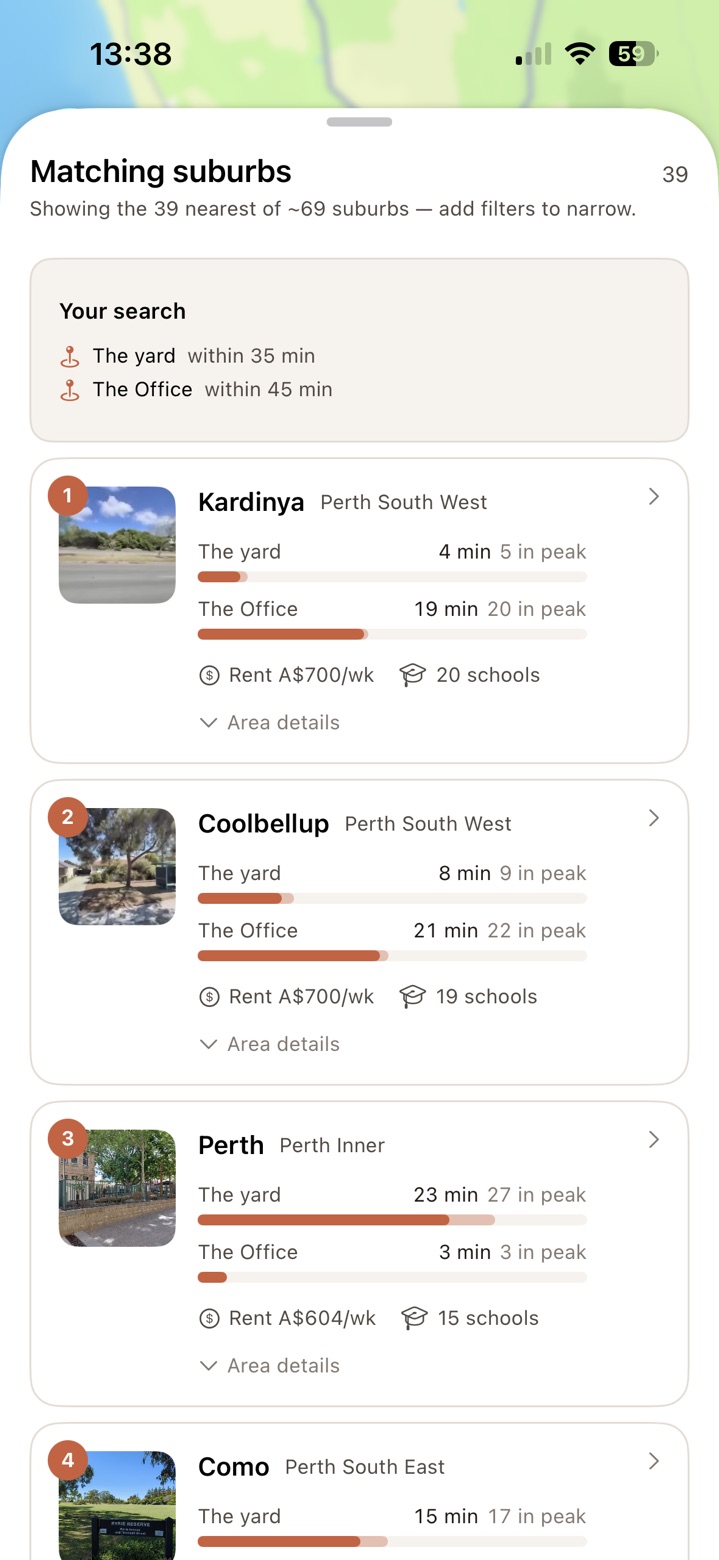
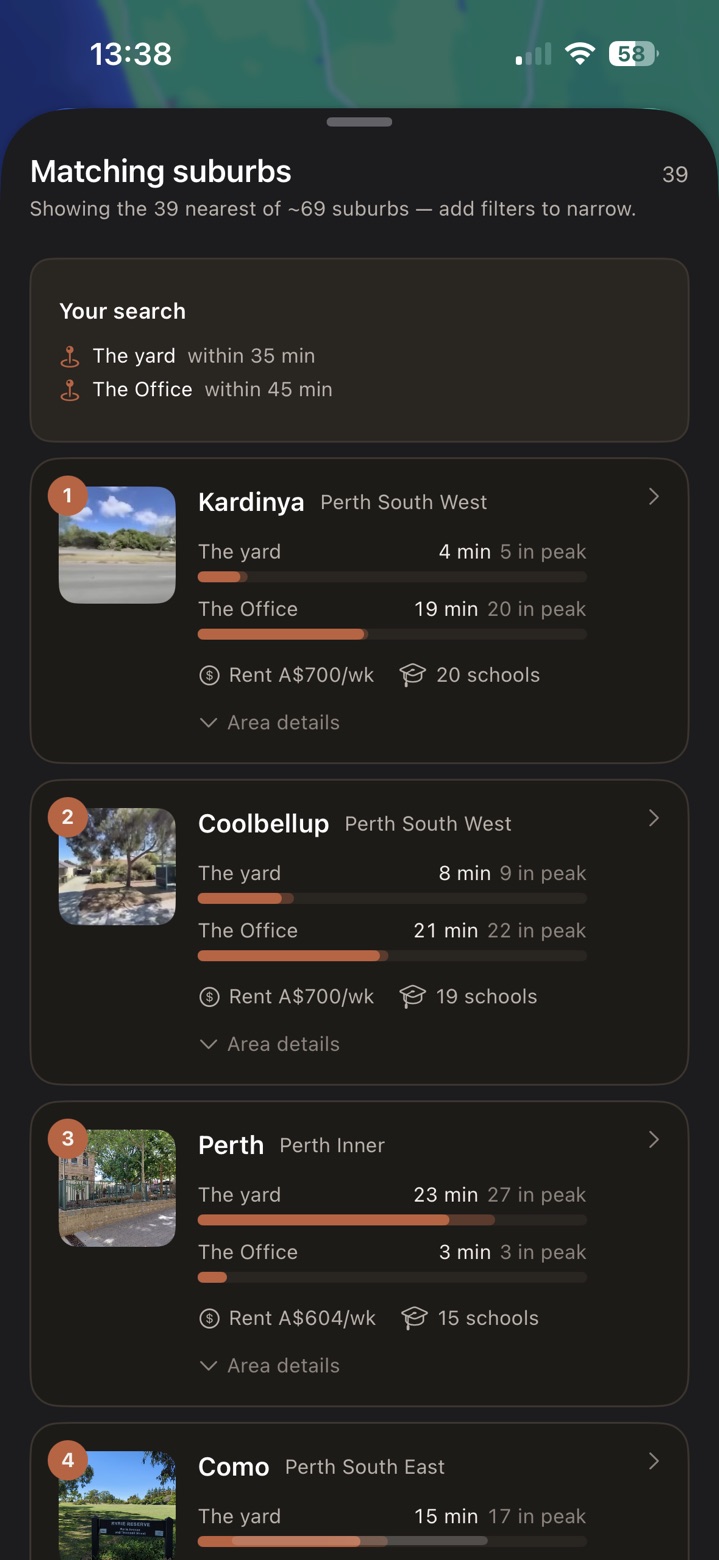
About sixty-nine suburbs match, the list shows the nearest thirty-nine, and reading through it the map falls into three groups.
The list itself
1 to 4
5 to 8
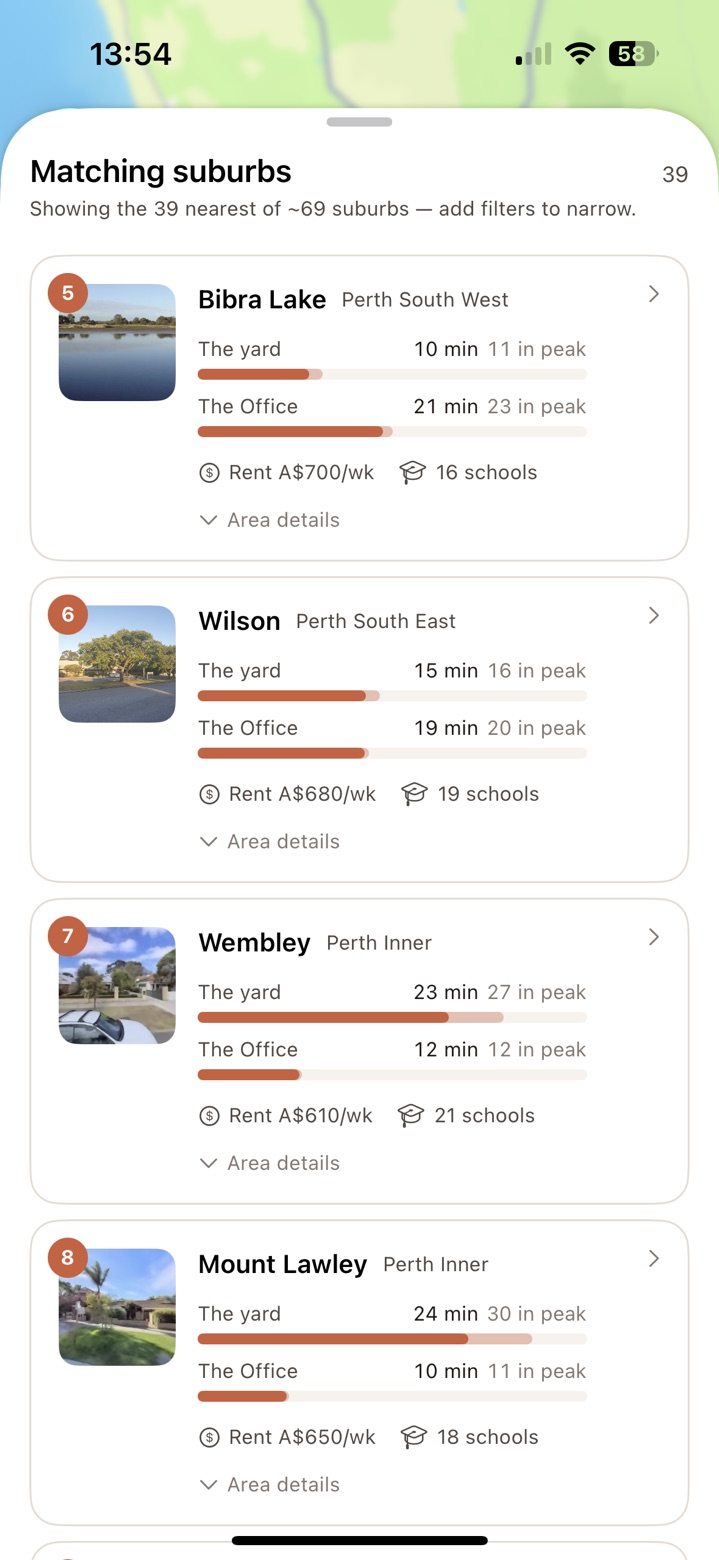
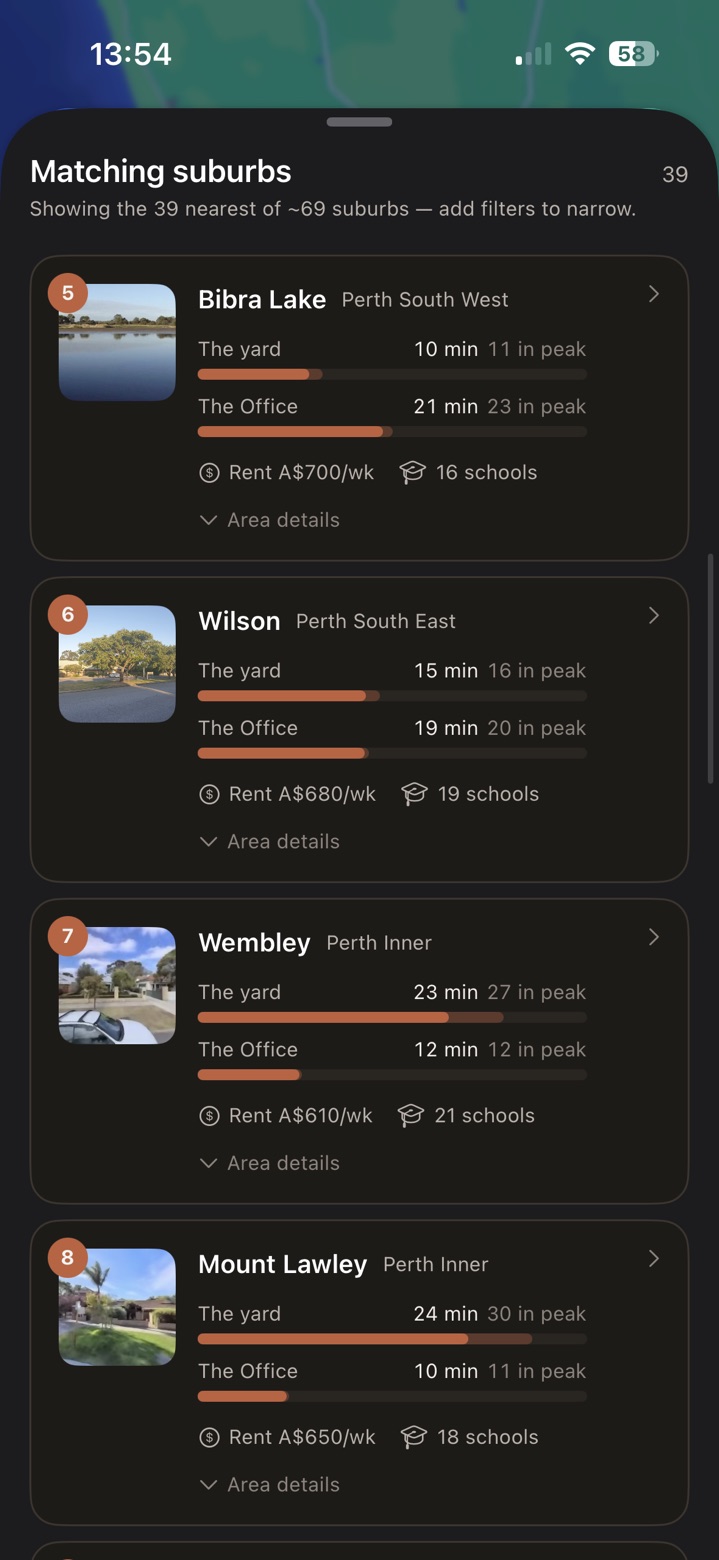
8 to 11
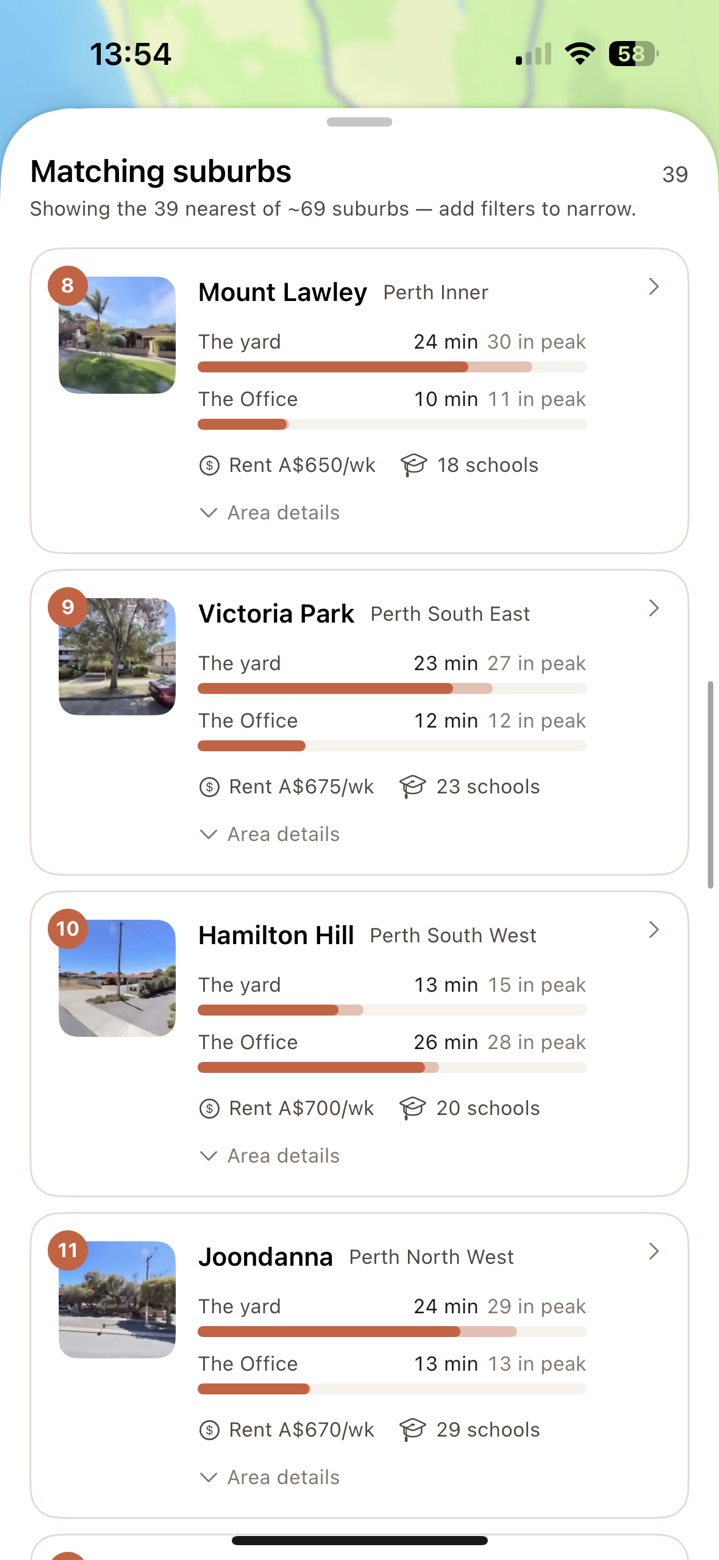
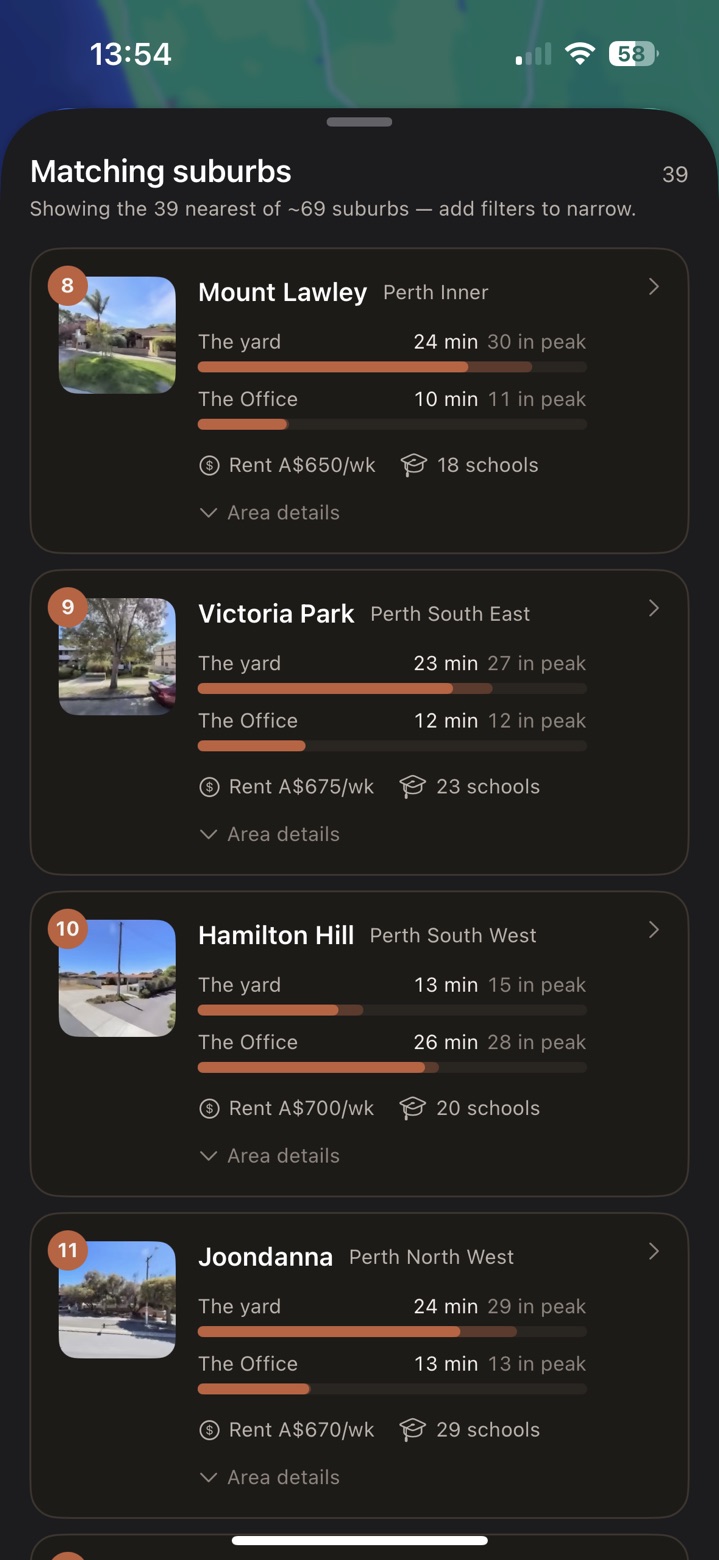
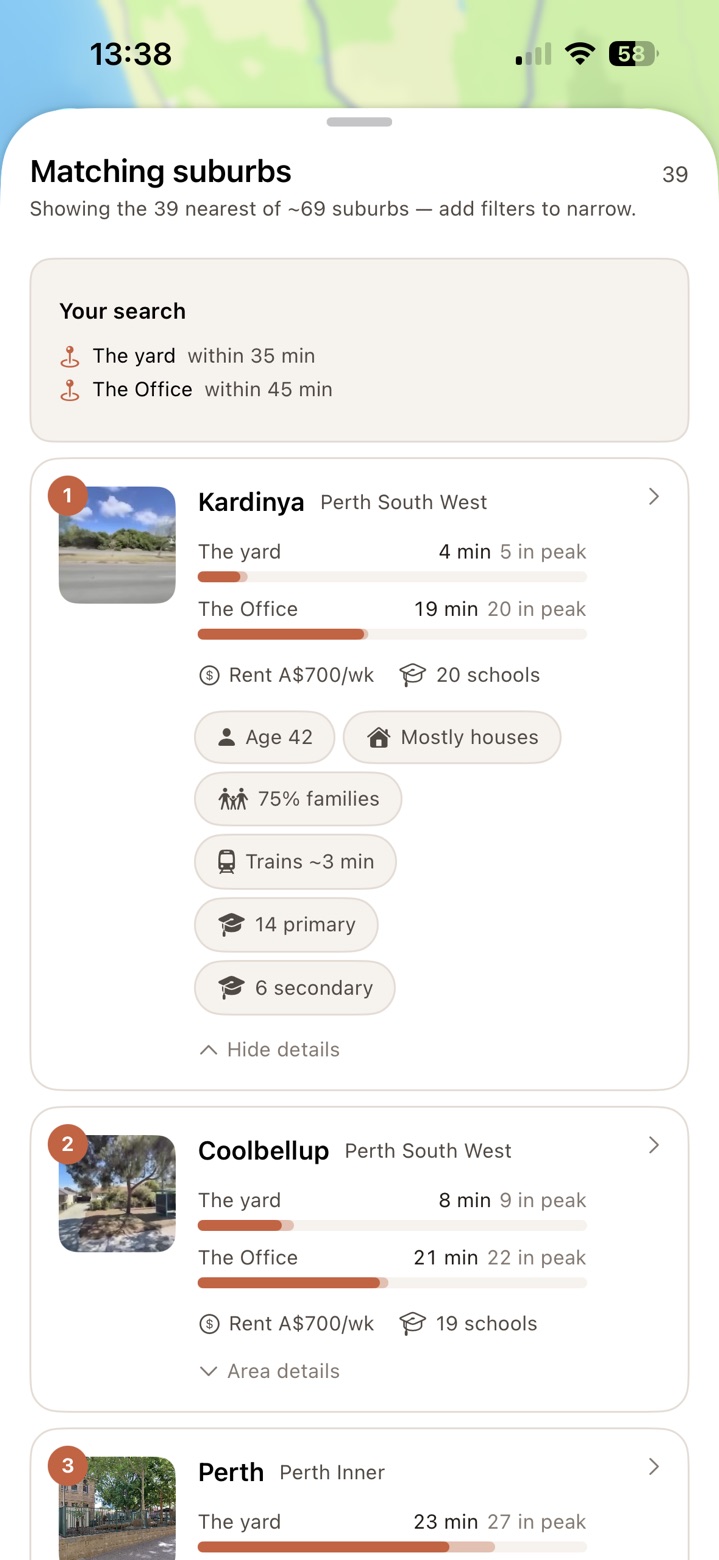
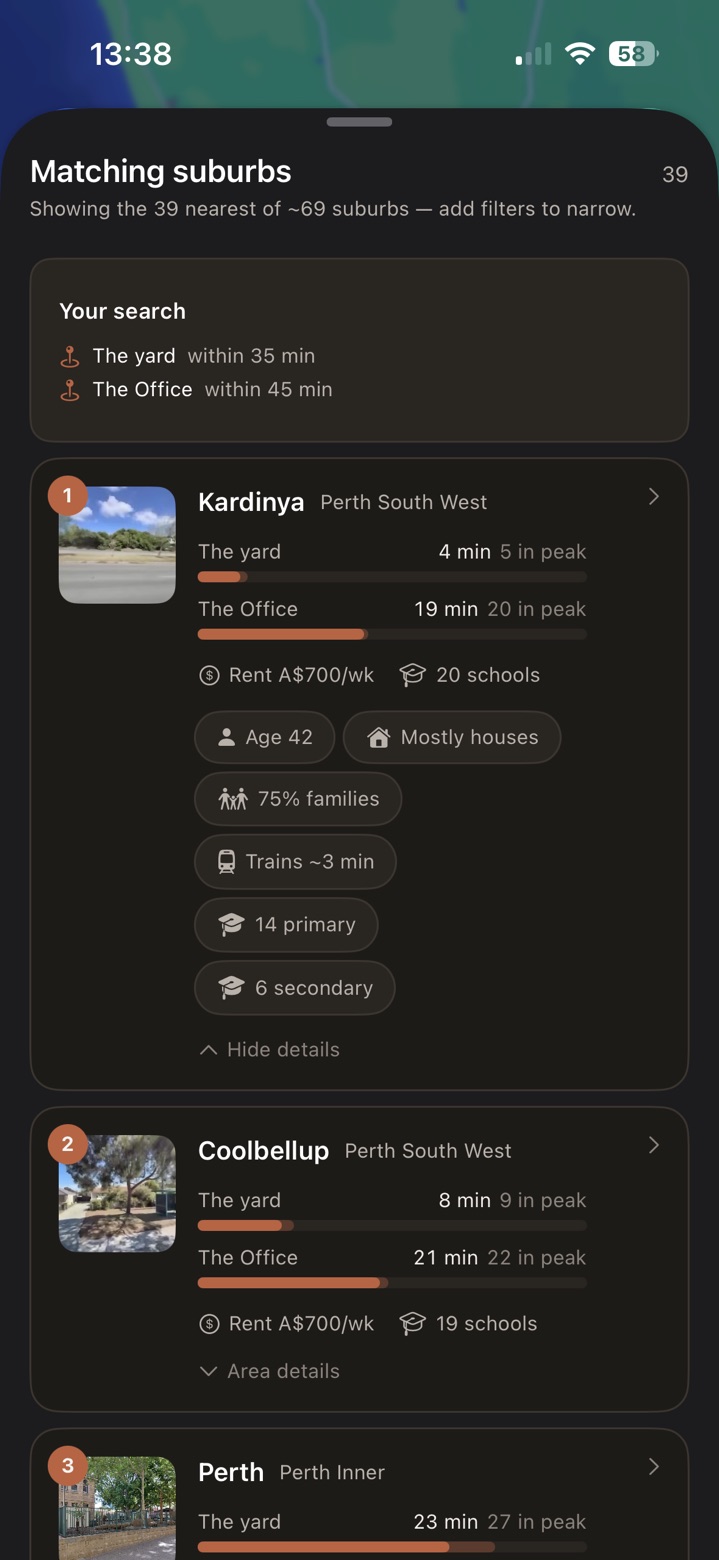
There is a south-west group that suits the carpenter and makes the partner drive, which is Kardinya at five minutes from the yard and twenty into the city, then Coolbellup at nine and twenty-two, Bibra Lake at eleven and twenty-three, and Hamilton Hill at fifteen and twenty-eight. Then there is a ring of inner suburbs that flips it the other way, where Perth itself is twenty-seven minutes from the yard and three from the partner's desk, Wembley and Victoria Park are both twenty-seven and twelve, and Mount Lawley is thirty and eleven. And then there is a middle, where neither of them wins and neither of them really loses, which is Como at seventeen and fifteen and Wilson at sixteen and twenty.
Two fixed points, and everywhere the list put them
- Close to the yard, longer to the city
- Close to the city, longer to the yard
- Splits it
The bit worth stopping on
Kardinya comes out on top and I don't think anybody would have guessed it. Five minutes to the yard and twenty into the city both sit a long way inside what the family said they would put up with, which means neither of them is spending their life in the car to make the other one's job work. Three quarters of the households there are families, it is mostly houses rather than flats, and there are fourteen primary schools and six secondary. Murdoch station is three and a half kilometres up the road, with twenty-four trains an hour at peak and a direct line into the city.
The one nobody would have picked
The rent is seven hundred, so they would be sat right at the top of what they said they could pay, and that is the trade you are making. Better to see it than to be told about it later.
The obvious answer is the wrong one
Look at the city entry again, because Perth comes third on this list and it earns it on paper. It has the cheapest rent of anything in the top ten at six hundred and four a week, a station a minute away, and three minutes to the office. For a family who have just arrived somewhere new and want to be central while they work the place out, that is the obvious move.
Third on the list, and still the wrong answer
Kardinya
Short to the yard, comfortable to the city.
Perth
Nearly at the limit one way, three minutes the other.
It is also mostly apartments, 45 percent families, and twenty-seven minutes from the yard, which is more than five times the Kardinya figure and the thick end of the carpenter's budget every morning. For two adults with no kids it is probably the right answer. For this family it fails on both of the things they actually said mattered, and it fails while sitting third.
That is the part I would want anybody to take from this. The suburb that suits your situation is rarely the one you would have named, and you won't get to it by reading lists of the best suburbs in Perth, because those lists have no idea where either of you has to be on a Tuesday morning.
What you'd do with it
You favourite the middle group and the top of the south-west group, and then you go and look at rentals in five suburbs instead of fifty. If the firm is putting you up for a few weeks when you land, you already know which side of the river you want that to be on.
None of this tells you whether you would actually like living in Kardinya, and that is a question for a weekend and a car once you are there. What it does is stop you spending the first month of a new life in a new country working out that the cheap flat with the good train line is fifty minutes from the yard in traffic.